Tendon Vibration
For Creting Movement Illusions in Virtual Reality
When I started my PhD, the new collaborators introduced me to this whole new world of sensory simulation and integration. Neuroscience was a big part of the new team, and I learned much about our senses and how they relate to movement and learning. This project aimed to improve hand redirection by incorporating insights from neuroscience.

Perception of body movement, such as moving your arms, is created by integrating multiple senses. Proprioception plays a role in perceiving our limb position and movement by sensing the mechanical forces and muscle and tendon stretch. Neuroscience studies human proprioception, thereby creating a technique called tendon vibration. By stimulating tendons with vibrations, we can fake sensations of muscle and tendon stretch.


A vibration motor stimulating the bicep tendons will create an illusion of elbow extension, while stimulated tricep tendons create an illusion of elbow flexing. In theory, tendon vibration should improve hand redirection. Because matching the illusory visual and proprioceptive arm movements creates a stronger integrated illusion.


Tendon vibration by that point was investigated only under restricted arm movements. The elbow was locked in horizontal motion only, removing variables such as gravity's influence and active shoulder engagement. The approach to realizing tendon vibration for hand redirection was to investigate movements more realistic for VR applications.

The first step was to create a vibration motor setup capable of producing robust illusions during active movement. The tendon vibration setup was based on previous work and further refined through our iterative design process. We provided guidelines for anyone reading our work so they can also implement tendon vibration in their research and VR applications.

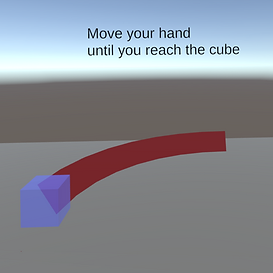
In the first study, we confirmed that our tendon vibration setup creates proprioceptive illusions for unrestrained arm movements. The participants had to rely on proprioceptive feedback alone to reach a target. This was ensured by hiding participants' hands during reaching, forcing them to rely solely on proprioception. Tendon vibration alters proprioception, so proprioceptive illusions can be confirmed by participants reaching the wrong position.

Tendon vibration created the illusion that the arm was moving faster. Therefore, participants undershoot the target because they perceive their arms moving faster and farther. However, illusions of slower arm movement did not work. Tendon vibration fails to affect receptors in muscles that primarily drive the movement (agonist).

In the next step, we performed a detection threshold study with hand redirection. The second study was very similar to the first one. The participants virtual hands were manipulated to move faster by up to 25%, and they had to report if they perceived the visual manipulation.


Detection tresholds with tendon vibration were marginally improved, showing the potential of integrating multi sensory illusions.


After the second study, we wanted to create a more realistic perspective on tendon vibration implementationin VR applications. We used data from the second study to build a simulation that predicts detection thresholds for complex movements. While our initial study focused on three fundamental movement directions, real-world VR movements can involve combinations of those three. Our simulation accounts for how much vertical lift and forward movement contribute to the overall movements. These two factors, gravity and shoulder movement, affect tendon vibration potency.